

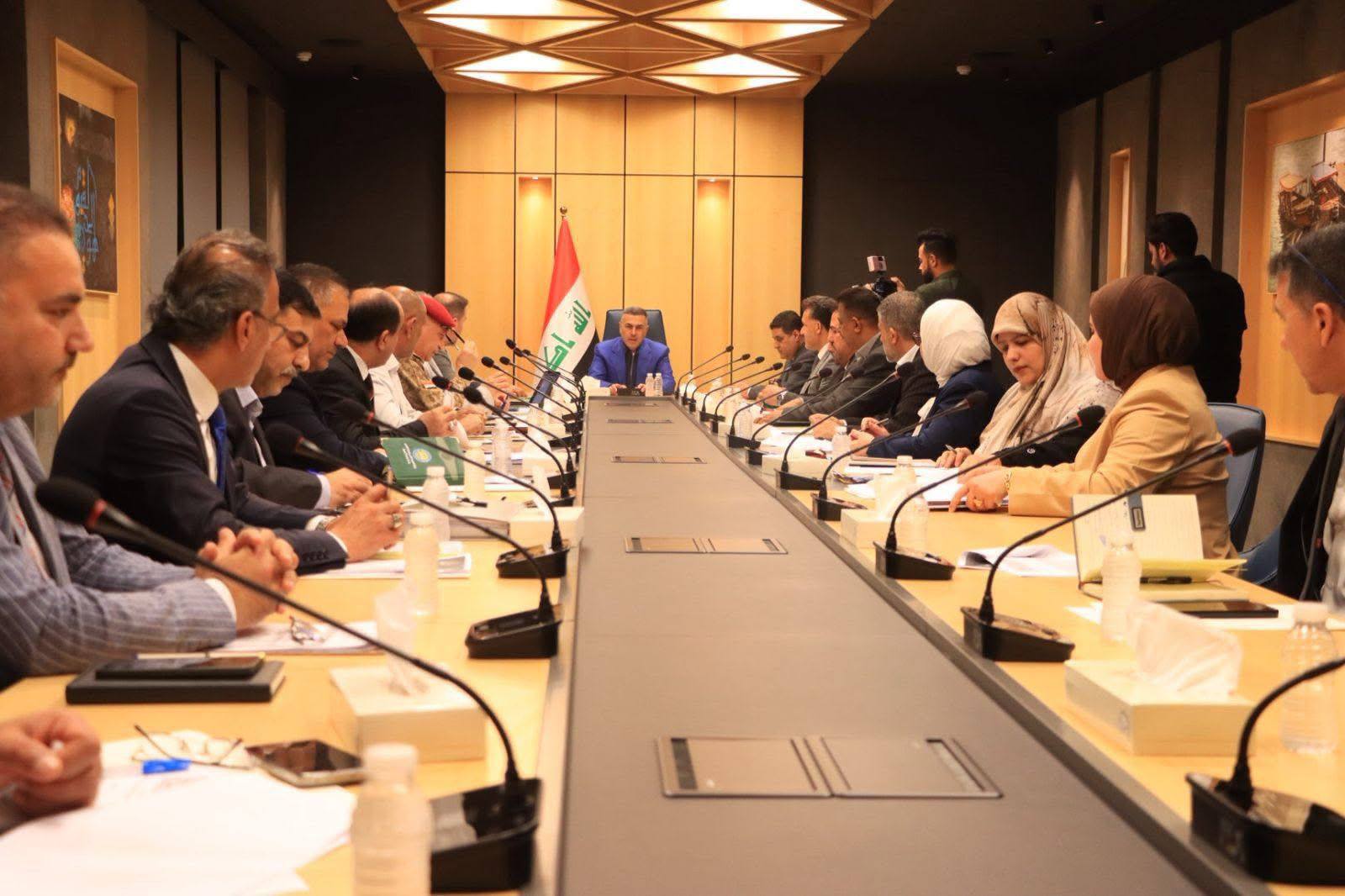
In the presence of the Director General of the Marine Sciences Center at the University of Basra, Assistant Professor Dr. Abdul-Amir Rahim Jassim, a member of the Council for Environmental Protection and Improvement, the Council, chaired by Governor Asaad Al-Eidani, held an expanded meeting attended by the directors of supporting departments to discuss urgent measures to address the water scarcity crisis facing a number of regions and to develop solutions.
The meeting reviewed the on-the-ground challenges associated with declining water discharges and rising salinity levels, as well as exploring coordination mechanisms between academic, service, and technical entities to secure immediate and sustainable solutions that mitigate the crisis’s impact on the population and the agricultural and service sectors in Basra Governorate.
The Center’s Director General stated
that the Marine Science Center’s role in addressing the salt tongue is a living example of the complementary relationship between scientific research and executive institutions. While the government and relevant ministries (such as the Ministry of Water Resources) provide the political and executive will, the Center offers scientific expertise, accurate assessments, and solutions grounded in sound research.
He explained that “the Center works in a spirit of integration with the local government and institutions,” noting that
the water issue in Basra, and with it the “salt tongue” phenomenon as one of its most dangerous manifestations, is a top priority in the work of the Marine Sciences Center at the University of Basra. The Center’s role is not limited to that of an academic observer, but extends to include serving as a scientific advisor and a key actor in understanding this crisis and proposing solutions for it.
This meeting is part of a series of government initiatives aimed at containing the water crisis in Basra by unifying efforts between local administrations and academic institutions—including the Marine Sciences Center—and developing practical solutions based on a realistic assessment of urgent needs and long-term treatment plans.
Marine Sciences Center Media
Important News


viewed most
.jpg)
.png)