

University of Basra Holds Workshop on the Relationship Between Aquatic Organisms and Parasites
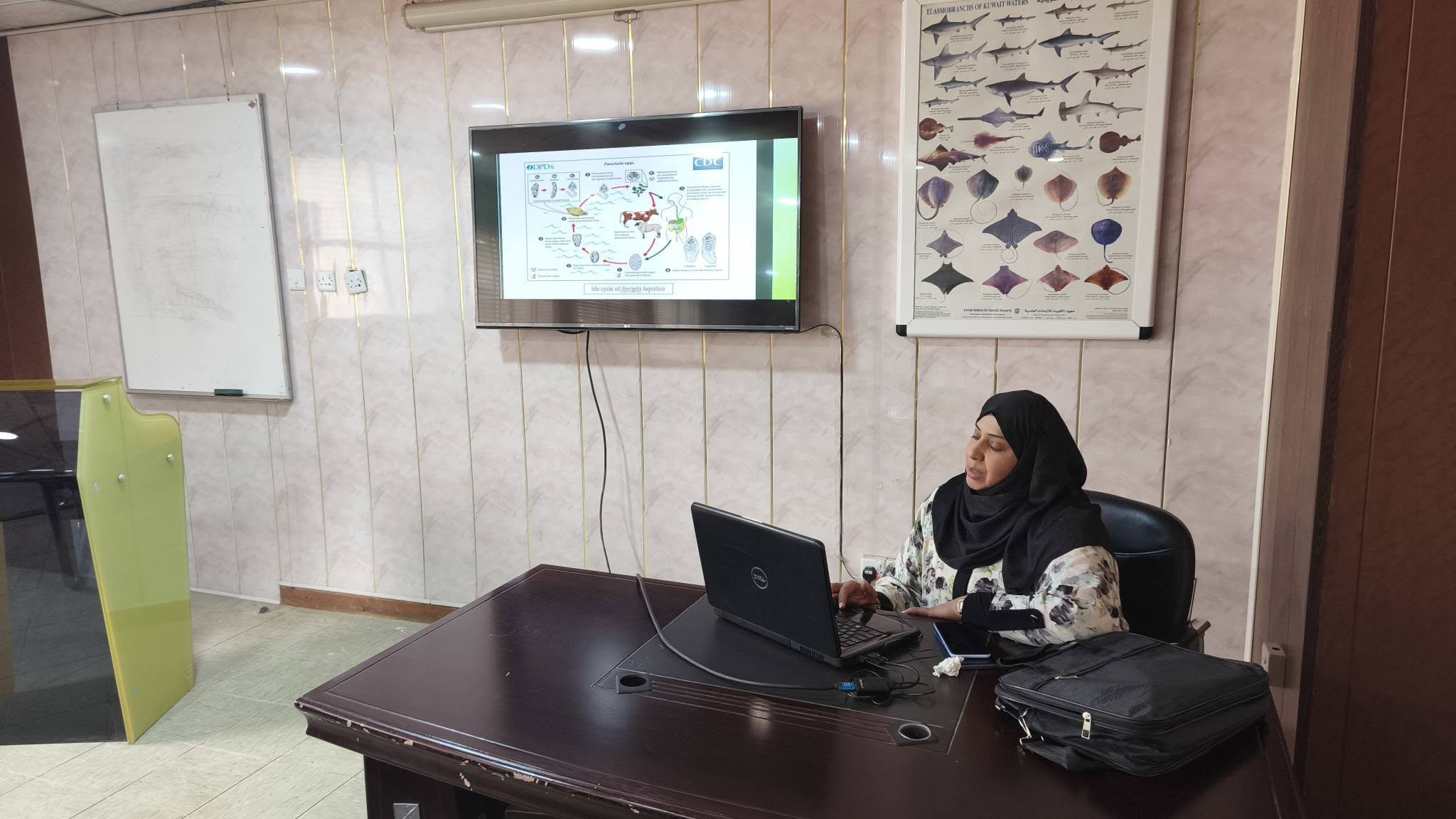
The Marine Sciences Center at the University of Basra organized a workshop titled “Aquatic Organisms as Intermediate Hosts for Certain Parasites.”
The workshop aimed to highlight the pivotal role of aquatic organisms such as fish, crustaceans, and mollusks in the life cycle of parasites and how they act as intermediate hosts to transmit the infection to definitive hosts, including humans and aquatic mammals.
The workshop, presented by lecturer Hanan Abdul Zahra Salboukh, covered several topics, including basic concepts such as the definition of intermediate and definitive hosts and the parasite life cycle, with a focus on the differences between them in aquatic environments. It also provided examples of important parasites that use aquatic organisms as intermediate hosts, including liver flukes such as Clonorchis sinensis and F asciola, where fish or aquatic snails act as intermediate hosts; tapeworms such as Diphyllobothrium latum, which rely on copepods and then fish as intermediate hosts; and protozoa such as Henneguya and Tetrahymena, which infect fish themselves, along with an explanation of how the parasite’s larval stages are transmitted to the intermediate host and how they reproduce or develop develop within it.
Important News


viewed most
.jpg)
.png)