

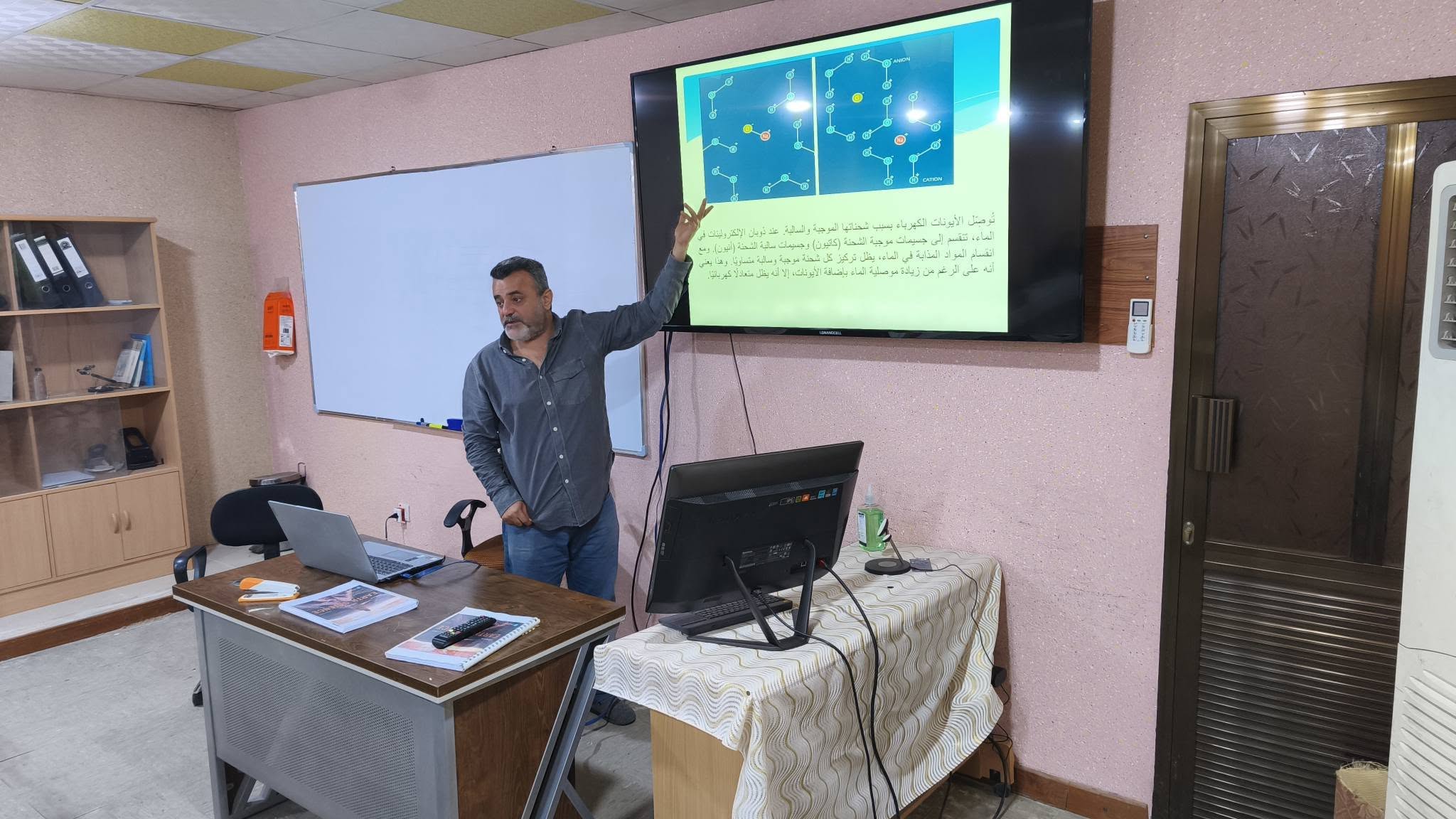
The Marine Science Center at the University of Basra organized a training course entitled “Determining Water Quality and the Relationship between Conductivity, Salinity, and Dissolved Solids.”
The course aimed to bridge the gap between knowing “what” conductivity and salinity are, understanding ‘how’ they are related to each other, and most importantly, “why” we measure them together to accurately and quickly diagnose water quality.
The course, presented by Dr. Muhannad Kazem Taher, included how to measure electrical conductivity (EC), which is the backbone of rapid water quality assessment, as it is an indirect and approximate indicator of both salinity and total dissolved solids (TDS).
The essence of the technical relationship between electrical conductivity, salinity, and total dissolved solids was explained.
The idea is based on the fact that pure (deionized) water is almost an insulator of electrical current. The presence of dissolved salts (such as chlorides, sulfates, and bicarbonates) increases its conductivity. Therefore, the values are calculated as follows:
· TDS (estimated) = EC (microSiemens/cm) × conversion factor (CF). This factor is not universal; it ranges from 0.55 to 0.8 depending on the ionic composition of the water, and is about 0.7 in ocean water.
· Salinity: Calculated from EC and temperature measurements using standard equations (PSS-78 practical salinity scale), which are essential in marine and low-salinity water applications.
Media and Government Communications Department
Important News


viewed most
.jpg)

.png)